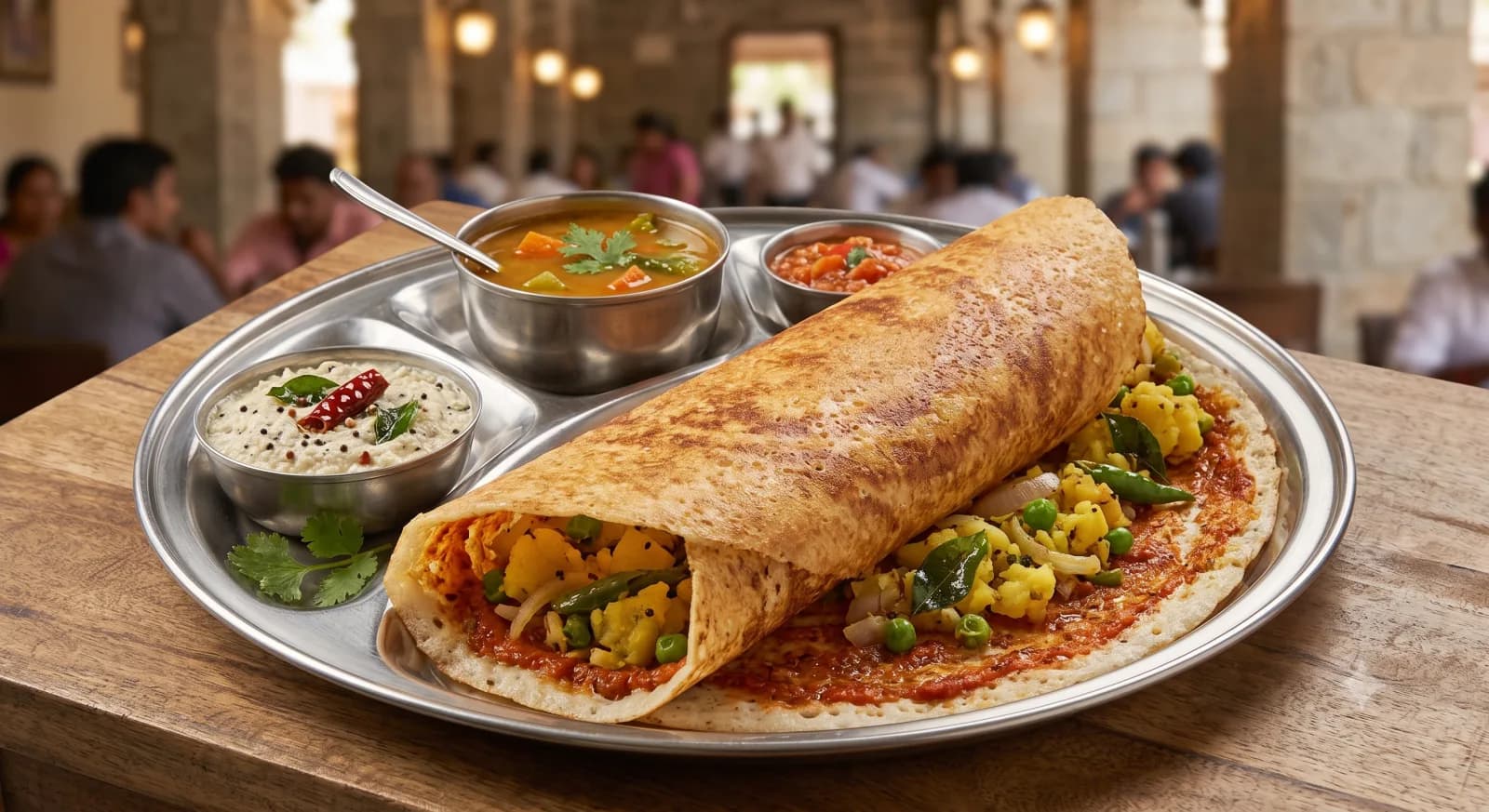
If you've only just discovered dosas, welcome — you're about to fall down a delicious rabbit hole. So, what is a dosa? In short: a thin, crispy crêpe made from fermented rice and lentil batter, a staple of South Indian cooking that's naturally vegan and gluten-free.
How a dosa is made
The batter is the whole story. Rice and urad dal (split black lentils) are soaked, ground and left to ferment overnight. That fermentation is what gives a dosa its signature tang and its lacy, crispy edges when it hits the hot griddle. No yeast, no wheat — just time and technique. It's then spread paper-thin and cooked until golden.
Served alongside you'll almost always get sambar (a tangy lentil stew) and a couple of chutneys — coconut, tomato or peanut.
The main types of dosa
Once you know the base, the variations are half the fun:
- Plain Dosa — the purest form: crispy, golden, nothing to hide behind.
- Masala Dosa — the classic, folded around a spiced potato filling. Start here.
- Mysore Masala Dosa — brushed with a fiery red chilli chutney inside. For spice lovers.
- Benne Dosa — a soft, buttery Karnataka style ("benne" means butter), rich and golden.
- Ghee Podi Dosa — dusted with spicy podi powder and ghee, savoury and aromatic.
- Family Dosa — an oversized, shareable dosa built for the table.
If it's your first time, order a Masala Dosa. It's the perfect introduction: crisp on the outside, soft spiced potato within.
Dosa vs idli: what's the difference?
Same batter, different technique. A dosa is spread thin and fried crisp; an idli is poured into moulds and steamed into soft, pillowy cakes. One is crunchy, one is cloud-like — and both are worth ordering.
Where to eat a great dosa in Utrecht
At VegNation in Utrecht, dosas are made to order from batter we ferment in-house, so they arrive hot and genuinely crisp. You'll find every style above on the menu, plus idlis, uthappams and the weekend unlimited brunch where you can taste several in one go. Come hungry — a good dosa is bigger than it looks.